Hattingen Hair
Valued member
A hair transplant cannot fully replace hair lost in a 1:1 ratio (100% restoration); a hair transplant therefore strives to achieve an illusion of thickness, placing the FU ´s (grafts) in such a way to cover a surface area that in reality used to have much more hair. This basic principle allows especially people with more aggressive hair loss patterns to be able to achieve if not total but almost total coverage with a natural looking thickness or density.
The Visual Appearance of Hair Loss:
Hair Loss becomes apparent when light penetrates the hair coverage and is reflected back off the scalp surface. Our eyes can only make sense of something if there is light, if it is pitch black; there is nothing for the eye to see. So, when there is enough density the light only reflects off the hair coverage and not the scalp, therefore blocking the appearance of light and the appearance of hair loss/thinning.
Miniaturisation
The MPB hair loss process is not a sudden occurrence, but rather a prolonged process of miniaturisation, where the hair life progressively shortens its growth phase, the hair shaft becomes thinner, does not grow as long or as fast. The loss of diameter of the hair shaft leads to a loss in the coverage potential of the hair; this in turn allows light rays to reach the skin surface. The reflection that bounces back into our eyes is more and more from the skin. We see this as thinning hair or hair loss.
The goal of a hair transplant is to redistribute a sufficient amount of healthy, permanent hair from the donor area to the area of hair loss, recipient area in order to block the reflection of light off the scalp and therefore to attain the appearance of fullness.
Simply put, to try to cast a substantial shadow on the skin in order to block the light rays.
Consider the fact that your donor density on the back of your head (occipital area) is usually around 80 FU s/cm ², whereas the density on the lateral sides is around 65-70 FU s/cm ². This difference of 10-15% less density is imperceptible to the naked eye. This is proof that sufficient coverage of the skin / blocking of light rays is achievable with less than 100% of the mathematical density.
There is therefore a difference between mathematical and aesthetic density, and this is a vital aspect that makes a hair transplant work.
Coverage but not at the expense of density
The question then is how much hair has to be redistributed in order to achieve the blocking of light and an aesthetically acceptable coverage?
This depends on the individual ´s characteristics or quality of the hair (thickness of the hair shaft, curl, colour contrast between hair and skin), but also the length of the hair shaft and the way the hair is combed /styled.
It is important to understand that the hair needs to have a certain length in order to be able to develop its coverage potential. The shorter the hair is cut then less shadowing/ coverage or fullness is achieved so for most people it is important to allow the hair to grow long enough to overlap the surrounding hair and therefore enjoy the maximum result of the transplanted hair.
Besides the above mentioned factors that are not influenced by the operating team, there are some technical tricks that we can use to maximise the coverage potential of transplanted hair. A more acute angle of the recipient incision allows the hair to lay flatter onto the skin, therefore obtaining a longer shadow. The method and technique of slit making, orientation and the use of custom blades allows for greater angulation control, recreates a naturally arranged pattern of FU s and ultimately lead to better coverage/ better illusion of density.
Hair characteristics, correct placement angle and orientation are commonly discussed to be important to gain the illusion of thickness and greater coverage.
We touched on this in another thread; one aspect that is rarely discussed if at all is the use of the natural curvature of the hair to gain maximum coverage from each hair, and allowing the hair to blend into the native hair more effectively, so even with a shorter cut the curvature does not contradict the surrounding hair.
[align=center]
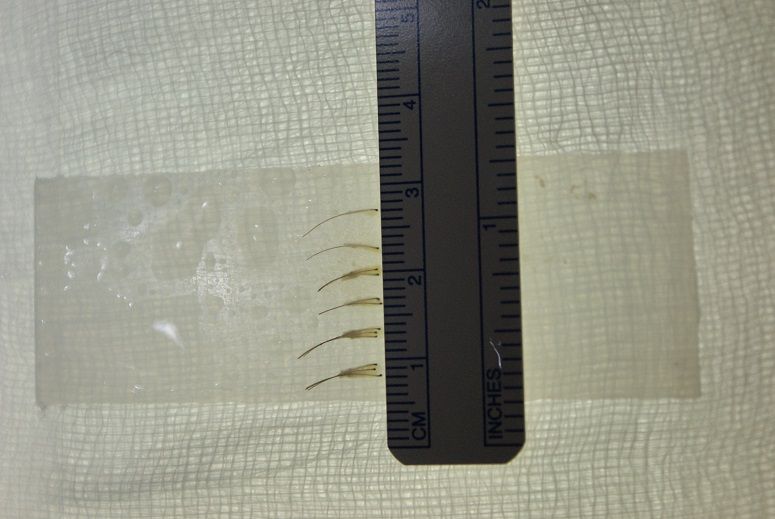
[/align][align=left]This shows the FU ´s after being removed and the natural curvature, below shows when placed in the recipient 2 FU ´s with opposing curvature placement, one up the other laying down.[/align]
[align=center]
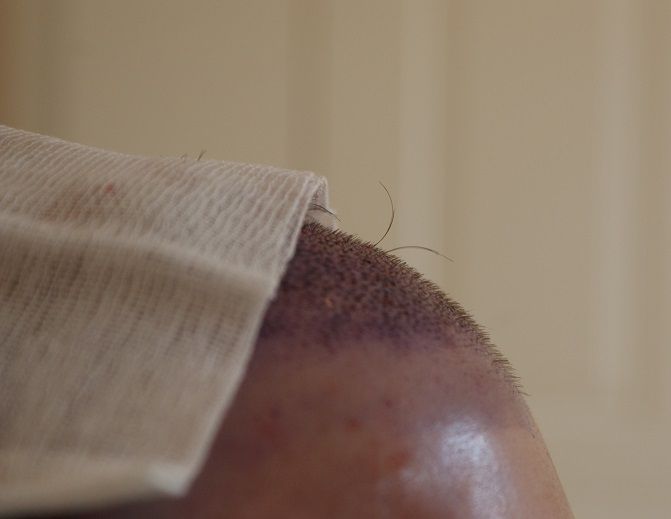
[/align][align=left] Even a straight hair has a curvature, the lay of the hair when it is held up or when in the scalp will always fall in a certain direction when it exits (usually with the curvature of the hair facing down, towards the scalp). When placing a hair in the recipient site the hair shaft of the graft requires a few mm ´s in order for the technician/placer to be able to determine the correct direction of the curvature. This is pain staking work and nothing to do with the way the recipient site (direction /angle) has been made, it is solely down to the technician checking each placement as it is made and adjusting accordingly which way the hair curvature falls. [/align][align=left]
To have enough hair length visible on the FU graft in order to correctly asses the direction of the curvature means that the hair cannot be close shaved in the donor when harvested. This proves problematic with FUE as the donor needs to be close shaved in order to precisely extract; it is easier with FUT as the donor area hair can be left longer. [/align][align=left]Placing the hair with the correct curvature to the surrounding hair has three major benefits, firstly it will blend with the surrounding hair and not give the appearance of misdirected hairs, secondly it will allow each hair to give greater coverage allowing for fewer grafts to be used over a specific area of the recipient and thirdly more fullness or density can be achieved as the hairs are laying in a uniform pattern.[/align][align=left]Hair transplants are a unique blend of strategic vision, understanding of mathematical and physical facts, technical prowess and artistic feel.
[/align]
The Visual Appearance of Hair Loss:
Hair Loss becomes apparent when light penetrates the hair coverage and is reflected back off the scalp surface. Our eyes can only make sense of something if there is light, if it is pitch black; there is nothing for the eye to see. So, when there is enough density the light only reflects off the hair coverage and not the scalp, therefore blocking the appearance of light and the appearance of hair loss/thinning.
Miniaturisation
The MPB hair loss process is not a sudden occurrence, but rather a prolonged process of miniaturisation, where the hair life progressively shortens its growth phase, the hair shaft becomes thinner, does not grow as long or as fast. The loss of diameter of the hair shaft leads to a loss in the coverage potential of the hair; this in turn allows light rays to reach the skin surface. The reflection that bounces back into our eyes is more and more from the skin. We see this as thinning hair or hair loss.
The goal of a hair transplant is to redistribute a sufficient amount of healthy, permanent hair from the donor area to the area of hair loss, recipient area in order to block the reflection of light off the scalp and therefore to attain the appearance of fullness.
Simply put, to try to cast a substantial shadow on the skin in order to block the light rays.
Consider the fact that your donor density on the back of your head (occipital area) is usually around 80 FU s/cm ², whereas the density on the lateral sides is around 65-70 FU s/cm ². This difference of 10-15% less density is imperceptible to the naked eye. This is proof that sufficient coverage of the skin / blocking of light rays is achievable with less than 100% of the mathematical density.
There is therefore a difference between mathematical and aesthetic density, and this is a vital aspect that makes a hair transplant work.
Coverage but not at the expense of density
The question then is how much hair has to be redistributed in order to achieve the blocking of light and an aesthetically acceptable coverage?
This depends on the individual ´s characteristics or quality of the hair (thickness of the hair shaft, curl, colour contrast between hair and skin), but also the length of the hair shaft and the way the hair is combed /styled.
It is important to understand that the hair needs to have a certain length in order to be able to develop its coverage potential. The shorter the hair is cut then less shadowing/ coverage or fullness is achieved so for most people it is important to allow the hair to grow long enough to overlap the surrounding hair and therefore enjoy the maximum result of the transplanted hair.
Besides the above mentioned factors that are not influenced by the operating team, there are some technical tricks that we can use to maximise the coverage potential of transplanted hair. A more acute angle of the recipient incision allows the hair to lay flatter onto the skin, therefore obtaining a longer shadow. The method and technique of slit making, orientation and the use of custom blades allows for greater angulation control, recreates a naturally arranged pattern of FU s and ultimately lead to better coverage/ better illusion of density.
Hair characteristics, correct placement angle and orientation are commonly discussed to be important to gain the illusion of thickness and greater coverage.
We touched on this in another thread; one aspect that is rarely discussed if at all is the use of the natural curvature of the hair to gain maximum coverage from each hair, and allowing the hair to blend into the native hair more effectively, so even with a shorter cut the curvature does not contradict the surrounding hair.
[align=center]
[/align][align=left]This shows the FU ´s after being removed and the natural curvature, below shows when placed in the recipient 2 FU ´s with opposing curvature placement, one up the other laying down.[/align]
[align=center]
[/align][align=left] Even a straight hair has a curvature, the lay of the hair when it is held up or when in the scalp will always fall in a certain direction when it exits (usually with the curvature of the hair facing down, towards the scalp). When placing a hair in the recipient site the hair shaft of the graft requires a few mm ´s in order for the technician/placer to be able to determine the correct direction of the curvature. This is pain staking work and nothing to do with the way the recipient site (direction /angle) has been made, it is solely down to the technician checking each placement as it is made and adjusting accordingly which way the hair curvature falls. [/align][align=left]
To have enough hair length visible on the FU graft in order to correctly asses the direction of the curvature means that the hair cannot be close shaved in the donor when harvested. This proves problematic with FUE as the donor needs to be close shaved in order to precisely extract; it is easier with FUT as the donor area hair can be left longer. [/align][align=left]Placing the hair with the correct curvature to the surrounding hair has three major benefits, firstly it will blend with the surrounding hair and not give the appearance of misdirected hairs, secondly it will allow each hair to give greater coverage allowing for fewer grafts to be used over a specific area of the recipient and thirdly more fullness or density can be achieved as the hairs are laying in a uniform pattern.[/align][align=left]Hair transplants are a unique blend of strategic vision, understanding of mathematical and physical facts, technical prowess and artistic feel.
[/align]