
• Welcome to Hair loss Experiences hair loss forum.

    Free impartial hair loss advice, hair transplant advice, hair loss medications and hair loss news.
    You can contact us directly at [email protected] if you experience any problems.

FUE Transection. What is this?

H

hairtech

member
Transections from FUE are from whatever device that the FUE clinic uses. That could be from a manual extraction, a rotary extraction or the newer robotic auto-device.

Now... having said this... a big topic over the years has been transection rates. A transection in FUE is when you go for a 3 haired graft and end up with a 2 haired graft. Or you go for a 4 haired graft and only end up with a 1 haired graft. The point is... you are transecting something within the natural graft. And the arguments over the years has been whether or not transection "rates"... the amount of transections for any natural graft is significant or not.

In my own opinion this is still a significant topic.

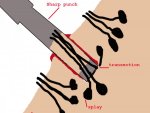
Below is a diagram of an fue punch going into the scalp and transecting a 3 haired graft. In this case 2 hairs are extracted and 1 hair is left behind.
 

Attachments
  • slot.gif.jpg
    slot.gif.jpg
    41.6 KB · Views: 2,844
Last edited:

sl

sl

BHR Clinic Patient Advisor
Liked the picture, as they say worth a thousand words.
 
topccat29

topccat29

29 year HT veteran
I have watched a few live strips procedures and the key seems to be able to go deep enough to be able to extract the tissue by lightly tugging at without going so deep as to transect the follicles below. It would seem to be that the same would apply here. So one would then ask why not use something motorized or robotic to perform a strip or for that matter anything that requires a scalpel. It would also seem to me that you would lose the feel that sense of touch that I personally find I have using some hand tools. Would this make any sense?

Maybe those that think they are doing HM are scoring so small while also not going deep enough to transect leaving a follicle or two behind that will most definitely grow back.
 
H

hairtech

member
Thank you sl I made this picture a long time ago lol.

Interesting point topcat. I have worked with a few really good strip clinics... In each case where there were more "less" transected follicles after they excised the strip was because they used proper eye magnification. They could dissect between the layers and the follicles without slicing through follicles. This in my opinion should be a standard but it is not. Many clinics still excise strips with zero magnification.

Moreover, in FUE... there is still a lack of proper magnification. I really cannot understand how this can be done because you really need to see the angle and actual follicle grouping to extract a graft. Transection rates dramatically for many other variables let alone a simple eye magnification. geesch!

'''h;h;;h
 
Prohairclinic

Prohairclinic

Prohairclinic Scalp Micro Pigmentation
Interesting topic.

At our clinic we have tried several motorized devices. Each an every one was given back to me to return to send.

The reason was always the same.

Doing manual extractions the extractor senses (fingertip feeling) transactions and it is clear that something must change (angle/depth).
Using Motorized devices there is no such feeling since the handle is heavy and vibrating. This causes transection to rise dramatically.

As for FUT transections there are many reasons to believe that the rates of transections are unknown.
Usually a team of tech, using scalpels are doing very precise work. Hopefully all tech have a lot of experience, but that is an unknown factor to the patient. There is basically no real control possible since it would mean that the dr. must stand next to each tech and obvserve every move.
 
Bigmac

Bigmac

Administrator
Staff member
What are the chances of the transected hair surviving and actually regrowing.
 
J

Jessop

Valued member
How many grafts would be lost on average? I've heard of doctors say they have less than 2% transection rate but people find these claims hard to believe.
 
H

hairtech

member
Bverrotti,

I am going to have to completely disagree with you on one part of your statement. But before I get to that I will agrre with you on a couple of points.

1. FUT transections are unknown. However in the most exerienced clinics there are quality controls employed. We have a senior tech checking everyones grafts. It is easy to spot transection issues in that are but not easliy quantified.

2. We also tried different rotary devices and we sent most of them back. And it was because of vibrations and bulkiness or flat out poor design. But we did settle on the safe system.

And here is where I have to disagree with you. A rotary device can in fact in the right set of skilled and experienced hands work. In my opinion the older method of FUE SHOULD BE LEARNED FIRST. Everyone should learn the feeling of the extraction using the manual extraction. And using this knowledge transfer the same senses and feeling to a rotary device if that is what is wanted. I do not think that a blanket statement for all rorary devices is fair. There are proven and time tested great results from rotary clinics... including ours.

Bigmac,

Good question. It is not exactly known however we have seen return patients after shaving their heads that would have like a 1 or 2 etc.. in an obviously extracted spot. This would prove a transection that grew.

Jessop,

In my opinion the experienced clinics can have low transection rates on an average, but I can gaurantee that no clinic can have a low transection rates on all patients. I also can gaurantee that inexperienced clinics will have a high transection rate. And any clinic that does not use magnification will have a high transection rate.
 
sl

sl

BHR Clinic Patient Advisor
Transected grafts can survive and re-grow in the original area and this happens often with plug removals for example whereby the angles and depth are hard to gauge and they can be wounded but regrow the hair after some time as they were not killed as such in the attempt to remove them and can be the same when a substantial part of the FU is left behind, so, a transection does not always mean a waste of a FU if this makes sense.

I personally had some chest hairs punched as a test many years ago, 50 in all, and a few grew back through the punch marks so I knew they had been transected but survived and grew again.

Then grafts are on times once harvested purposely split from 3,4 hairs per graft to lesser units and grow even though they have been purposely split into singles or two haired units etc if needed for the specific surgery.

As for our FUE we would agree the doctor prefers manual punches for tactile sensitivity reasons but this does not negate the fact that others may be happier with rotary devices and believe they have the same sensitivity.
 
Prohairclinic

Prohairclinic

Prohairclinic Scalp Micro Pigmentation
hairtech wrote:
Bverrotti,

I am going to have to completely disagree with you on one part of your statement. But before I get to that I will agrre with you on a couple of points.

1. FUT transections are unknown. However in the most exerienced clinics there are quality controls employed. We have a senior tech checking everyones grafts. It is easy to spot transection issues in that are but not easliy quantified.

2. We also tried different rotary devices and we sent most of them back. And it was because of vibrations and bulkiness or flat out poor design. But we did settle on the safe system.

And here is where I have to disagree with you. A rotary device can in fact in the right set of skilled and experienced hands work. In my opinion the older method of FUE SHOULD BE LEARNED FIRST. Everyone should learn the feeling of the extraction using the manual extraction. And using this knowledge transfer the same senses and feeling to a rotary device if that is what is wanted. I do not think that a blanket statement for all rorary devices is fair. There are proven and time tested great results from rotary clinics... including ours.

Bigmac,

Good question. It is not exactly known however we have seen return patients after shaving their heads that would have like a 1 or 2 etc.. in an obviously extracted spot. This would prove a transection that grew.

Jessop,

In my opinion the experienced clinics can have low transection rates on an average, but I can gaurantee that no clinic can have a low transection rates on all patients. I also can gaurantee that inexperienced clinics will have a high transection rate. And any clinic that does not use magnification will have a high transection rate.

Ok, it is ok to disagree, it would be a boring world if we always agree on everything.
Time and results will prove if robots can master human fingertip feeling.

And for the record, I do agree with you on your last paragraph ;)

What magnification are you using now for manual extractions?

B
 
topccat29

topccat29

29 year HT veteran
If the older method of fue extraction with a manual punch should be learned by everyone then why should someone move on to a rotary device, for what reason?
 
H

hairtech

member
SL,

Good post.

Bverotti,

I know it is ok to disagree. And also I did not say that robots can master fingertips or feeling of the manual technique. What I did state is that the fingertips and feeling can be transferred to a hand held rotary device if needed. Manual extraction, rotary devices and robotic extractions are all different techniques.

Topcat,

The reason in our instance to switch to a rotary device after the mastery of the manual extraction was because with the Harris safe rotary device it reduced transection rates even further than what they were in general at our clinic. It also increased efficiency and sustained quality.

Believe me the transition was not taken lightly and this was a not an easy task.

Now after 3 years of using this device it is proven in my opinion. And furthermore, it uses the 0.8mm, 0.9mm, and 1.0mm only.

This is just my opinion and my experience at my clinic. Not all clinics agree and there are definitely several good
FUE clinics that use manual and rotary FUE extractions.
 
Bigmac

Bigmac

Administrator
Staff member
hairtech wrote:
Bigmac,

Good question. It is not exactly known however we have seen return patients after shaving their heads that would have like a 1 or 2 etc.. in an obviously extracted spot. This would prove a transection that grew.
Thanks Hairtech.
 
Top