
Sabine-Prohairclinic
FUE hair transplantation - SMP
A hot topic seems to be the transection rate during FUE procedures. Maybe it is a good time to expand on transections during FUE treatments. Before reading the following I would like to point out that FUE is a general term and there are many versions of FUE. Obviously, this writing will only cover the FUE as we perform it, using our routines, our instruments, our protocols and our assistants. If you want to see different versions of FUE in action I suggest taking a look at youtube and you will see FUE footages presented by many clinics worldwide.
Our definition of a transection
Let us define what is a transection in order to clear out any misunderstanding.
In our view there are really 2 different types of transections, normal transection and mortal transection.
Both are obviously unwanted, but one type has very different consequences than the type.
Mortal transection
The scoring instrument, a hollow needle that we usually refer to as a punch, in inserted too deep into the donor skin. The sharp edge of the punch will hit the vital elements of a hair follicle located at the lower 1/3, destroying its capability to reproduce hair. Mortal transections cause a net loss of hair.
Normal transection
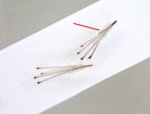
A normal transection can occur when the angle of the punch is not perfectly aligned with the hair shaft. A normal transection cuts through the hair (see picture, red line indicates where a hair has been cut under the skin),but does not touch the vital parts of the follicle (much deeper). A normal transection will cut the hair just as a hairstylist cuts hair and therefore it will just regrow. Normal transections do not cause a net loss of hair.
How mortal transection are avoided
Obviously mortal transections are undesired since they lead to irreversible net hair loss.
In our protocol, a few grafts are scored when starting the extraction process. After removing the grafts from the skin they are examined and the graft depth/length is determined. Graft depth hardly ever changes on the same patient throughout the donor area. The extraction instruments depth control is adjusted to less than the length of the graft, just allowing for the skin to be perforated. This is a crucial step (and quite simple as well) to avoid damaging vital follicle elements. Furthermore it will avoid unnecessary fibrosis.
Normal transections > the angle is your friend
Once depth control has been set, the surgeon has to focus on the angle of the hair shaft. Hand-eye control is crucial at this stage. Using high magnification loupes the angle of the hairs exiting the skin is very visible. The extraction instrument (punch) is inserted into the skin, following the same angle.
If the angle is correct, the depth is controlled by the instrument, a rotating motion of the punch will score the graft, loosening the adhesive tissue holding the follicle in place. The rotation motion will avoid compression. A tweezer is used to pull out the graft, again using virtually no traction force.
Tool size and transections
It is important to use the correct punch diameter for a few reasons :
The punch opening needs to be big enough to be able to fit 1-4 hair grafts, the most common grafts.
A punch that is too small will lead to normal transections
A punch that is too large may cause normal transections to adjacent grafts.
Large punches will also cause the extracted grafts to carry extra fat and/or skin tissue. This extra tissue has to be removed using sharp instruments. This is a delicate step to be performed under a microscope, requiring great hand-eye coordination and therefore the grafts are exposed to human error and possibly mortal transection. Grafts may dry out during this extra step, killing the follicle unit.
Experience
The learning curve of putting together all the pieces of the extraction process is steep, everything has to fit. Furthermore, it takes highly trained assistants to make it possible for a graft to make a safe passage from the donor area to the recipient zone. A team of assistants is useless without the skill of the surgeons, and the surgeon is depending on his assistants to make it possible to execute hundreds or thousands of little grafts. It would be inconceivable for us to offer FUE mega sessions if we did not have the routine to practice it daily. This is in our vision the only good way of offering extremely high quality FUE hair transplantation.
Facit
Mortal transection are possible at the very start of the procedure, before adjusting depth control. After depth control has been set, ( after 10-20 trials), mortal transections are no longer an issue. Normal transections are still possible but limited through the experience of the surgeon. Even if normal transection occur, they are not causing a net hair loss since the transected hair will regrow in the donor area. The surgeon has to develope a feeling for the grafts by performing FUE on a daily basis. Therefore the FUE routines that we use can limit the mortal transections to less than 1 %,. Normal transection rate is less than 5% on any type of hair or skin characteristic.
Picture attachement :
Normal transection: orginal 5 hair graft, 4 bulbs intact to be transplanted. The transected 5th hair will regrow from the donor area since the bulb and other vital elements are unharmed.
Our definition of a transection
Let us define what is a transection in order to clear out any misunderstanding.
In our view there are really 2 different types of transections, normal transection and mortal transection.
Both are obviously unwanted, but one type has very different consequences than the type.
Mortal transection
The scoring instrument, a hollow needle that we usually refer to as a punch, in inserted too deep into the donor skin. The sharp edge of the punch will hit the vital elements of a hair follicle located at the lower 1/3, destroying its capability to reproduce hair. Mortal transections cause a net loss of hair.
Normal transection
A normal transection can occur when the angle of the punch is not perfectly aligned with the hair shaft. A normal transection cuts through the hair (see picture, red line indicates where a hair has been cut under the skin),but does not touch the vital parts of the follicle (much deeper). A normal transection will cut the hair just as a hairstylist cuts hair and therefore it will just regrow. Normal transections do not cause a net loss of hair.
How mortal transection are avoided
Obviously mortal transections are undesired since they lead to irreversible net hair loss.
In our protocol, a few grafts are scored when starting the extraction process. After removing the grafts from the skin they are examined and the graft depth/length is determined. Graft depth hardly ever changes on the same patient throughout the donor area. The extraction instruments depth control is adjusted to less than the length of the graft, just allowing for the skin to be perforated. This is a crucial step (and quite simple as well) to avoid damaging vital follicle elements. Furthermore it will avoid unnecessary fibrosis.
Normal transections > the angle is your friend
Once depth control has been set, the surgeon has to focus on the angle of the hair shaft. Hand-eye control is crucial at this stage. Using high magnification loupes the angle of the hairs exiting the skin is very visible. The extraction instrument (punch) is inserted into the skin, following the same angle.
If the angle is correct, the depth is controlled by the instrument, a rotating motion of the punch will score the graft, loosening the adhesive tissue holding the follicle in place. The rotation motion will avoid compression. A tweezer is used to pull out the graft, again using virtually no traction force.
Tool size and transections
It is important to use the correct punch diameter for a few reasons :
The punch opening needs to be big enough to be able to fit 1-4 hair grafts, the most common grafts.
A punch that is too small will lead to normal transections
A punch that is too large may cause normal transections to adjacent grafts.
Large punches will also cause the extracted grafts to carry extra fat and/or skin tissue. This extra tissue has to be removed using sharp instruments. This is a delicate step to be performed under a microscope, requiring great hand-eye coordination and therefore the grafts are exposed to human error and possibly mortal transection. Grafts may dry out during this extra step, killing the follicle unit.
Experience
The learning curve of putting together all the pieces of the extraction process is steep, everything has to fit. Furthermore, it takes highly trained assistants to make it possible for a graft to make a safe passage from the donor area to the recipient zone. A team of assistants is useless without the skill of the surgeons, and the surgeon is depending on his assistants to make it possible to execute hundreds or thousands of little grafts. It would be inconceivable for us to offer FUE mega sessions if we did not have the routine to practice it daily. This is in our vision the only good way of offering extremely high quality FUE hair transplantation.
Facit
Mortal transection are possible at the very start of the procedure, before adjusting depth control. After depth control has been set, ( after 10-20 trials), mortal transections are no longer an issue. Normal transections are still possible but limited through the experience of the surgeon. Even if normal transection occur, they are not causing a net hair loss since the transected hair will regrow in the donor area. The surgeon has to develope a feeling for the grafts by performing FUE on a daily basis. Therefore the FUE routines that we use can limit the mortal transections to less than 1 %,. Normal transection rate is less than 5% on any type of hair or skin characteristic.
Picture attachement :
Normal transection: orginal 5 hair graft, 4 bulbs intact to be transplanted. The transected 5th hair will regrow from the donor area since the bulb and other vital elements are unharmed.