
M
Maynat82
member
Hi there,
I am a 43 year old female and have suffered from androgenetc alopecia since I was around 18. Over the last 6 or so months, I have noticed patches of redness that comes up and I sometimes have a burning and tingling sensation. My hair is starting to thin from the nape of the neck up, and the front left side of my crown is worse than my right. I have also lost all the hair on my arms and legs and my eyevrows have thinned.
I have seen 4 dermatologists. The first one said it looks like Lichen Planopilaris. The second one (who was overseeing the first derm) said its Androgenetic alopecia and refused to do a biopsy.
3rd derm said its androgentic alopecia amd either alopecia areata or alopecia areata incongnito and wouldnt do a biopsy.
4th one said its Telogen Effluvium and did a biopsy, but not from an area where there is active inflammation. The result came back as negative for androgenetic alopecia and a telogen catagen count of 16.7%, so they classed it as telogen effluvium.
My GP also did a scalp biopsy, however the sample wasn't big enough to provide a diagnosis, but it does state the following:
"One of the hair follicles appears essentially normal. The other partially visualised hair follicle shows mild peri follicular fibrosis,. with an associated increase in perl follicular mucin, and follicular plugging. An very isolated apoptotic keratinocyte is noted in the hair follicle epithelium, There is minimal inflammation. There is some scarring of the surrounding dermis .The hair follicles show non—specific perifollicular follicular changes which could be compatible with a lichenoid process such as lichen planopilaris."
Now this has left me very confused. The Dermatologists don't seem to want to listen. They also don't want to do a biopsy at the front of my scalp, due to scarring, but thats where alot of the inflammation is. My hair hasn't been coming out in clumps like you would expect with TE and my iron, vitamin D and hormones (including DHT) are all normal. I also can't identify any triggers for TE.
I have attached some photos of what my scalp looks like. Please note: Sub derm has been ruled out.

I am a 43 year old female and have suffered from androgenetc alopecia since I was around 18. Over the last 6 or so months, I have noticed patches of redness that comes up and I sometimes have a burning and tingling sensation. My hair is starting to thin from the nape of the neck up, and the front left side of my crown is worse than my right. I have also lost all the hair on my arms and legs and my eyevrows have thinned.
I have seen 4 dermatologists. The first one said it looks like Lichen Planopilaris. The second one (who was overseeing the first derm) said its Androgenetic alopecia and refused to do a biopsy.
3rd derm said its androgentic alopecia amd either alopecia areata or alopecia areata incongnito and wouldnt do a biopsy.
4th one said its Telogen Effluvium and did a biopsy, but not from an area where there is active inflammation. The result came back as negative for androgenetic alopecia and a telogen catagen count of 16.7%, so they classed it as telogen effluvium.
My GP also did a scalp biopsy, however the sample wasn't big enough to provide a diagnosis, but it does state the following:
"One of the hair follicles appears essentially normal. The other partially visualised hair follicle shows mild peri follicular fibrosis,. with an associated increase in perl follicular mucin, and follicular plugging. An very isolated apoptotic keratinocyte is noted in the hair follicle epithelium, There is minimal inflammation. There is some scarring of the surrounding dermis .The hair follicles show non—specific perifollicular follicular changes which could be compatible with a lichenoid process such as lichen planopilaris."
Now this has left me very confused. The Dermatologists don't seem to want to listen. They also don't want to do a biopsy at the front of my scalp, due to scarring, but thats where alot of the inflammation is. My hair hasn't been coming out in clumps like you would expect with TE and my iron, vitamin D and hormones (including DHT) are all normal. I also can't identify any triggers for TE.
I have attached some photos of what my scalp looks like. Please note: Sub derm has been ruled out.
Attachments
-
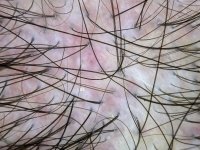 1000174758.jpg174 KB · Views: 136
 -
 Photo_2025-12-03 21_28_21_481.JPG82.4 KB · Views: 122
 -
 Photo_2025-12-03 12_27_35_752.JPG67.2 KB · Views: 124
 -
 Photo_2025-12-03 12_27_57_749.JPG71 KB · Views: 107
 -
 Photo_2025-12-03 12_24_54_551.JPG83.2 KB · Views: 161
 -
 Screenshot_20251202_203322_Gallery.jpg83.8 KB · Views: 146
 -
 20251202_125839.jpg124.3 KB · Views: 148
 -
 Photo_2025-12-02 11_51_34_520.JPG93.2 KB · Views: 146
 -
 Photo_2025-12-01 18_04_09_554.JPG80.5 KB · Views: 135
 -
 20251201_133921.jpg97.1 KB · Views: 162
 -
 Photo_2025-12-01 09_42_53_530.JPG73.6 KB · Views: 124
 -
 Photo_2025-12-01 09_45_51_186.JPG77.9 KB · Views: 112
 -
 Photo_2025-12-01 09_42_03_856.JPG66 KB · Views: 101
 -
 Photo_2025-11-30 15_58_37_584.JPG71.3 KB · Views: 94
 -
 Screenshot_20251129_212817_Gallery.jpg67 KB · Views: 134
 -
 Photo_2025-11-29 18_45_40_637.JPG70.8 KB · Views: 115
 -
 Photo_2025-11-29 18_47_53_889.JPG64.1 KB · Views: 118
 -
 Photo_2025-11-28 20_58_17_320.JPG88.9 KB · Views: 157
 -
 Photo_2025-11-28 20_56_59_722.JPG83.6 KB · Views: 144
 -
 Photo_2025-11-28 20_42_28_440.JPG61.1 KB · Views: 140
 -
 Photo_2025-12-01 09_44_22_855.JPG66.8 KB · Views: 141