• Welcome to Hair loss Experiences hair loss forum.

    Free impartial hair loss advice, hair transplant advice, hair loss medications and hair loss news.
    You can contact us directly at [email protected] if you experience any problems.

Over harvesting donor hair

Bigmac

Bigmac

Administrator
Staff member
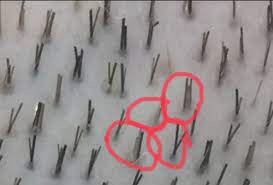
I have had a few concerned patients ask if they were over harvested and what does it mean. If grafts are removed without the appropriate spacing, that area will look sparse or even bald. This area has been over harvested. If the whole donor is treated this way, then the donor has been depleted. This means there will be fewer or no grafts available for future surgery.

A quick example below. 4 grafts extracted that are neighbours will leave an over harvested area.

32382A58-6DFF-4C5A-8F1E-8FB4AE06C4AA.jpeg
 
Last edited:
R

Ronnie

member
This is very interesting. Is there any sort of commonly accepted ‘correct’ harvesting pattern? So if I were to imagine a 10x10 selection of grafts, how many could be harvested before they were over harvested? Would it be say 25% of them, or maybe 33%? Obviously spaced out as evenly as possible. I guess maybe different people have grafts spaced closer or further apart and a different % of multigrafts so maybe there isn’t a ‘one size fits all’ approach?
 
NZK Medical

NZK Medical

Valued member
There are many factors that contribute to over-harvesting the donor area with the FUE technique. It is not only the % removed. Although that does play an important role. Natural hair characteristics good or bad will impact the numbers that can safely be removed. No different from the hair distribution over the recipient area. The better the hair characteristics the fewer hair units can be used over an area to give density and coverage. As a result, fewer hair units need to be removed from the donor.

Over-harvesting can also refer to the extraction pattern. For instance, if the pattern is isolated to a relatively small area. Leaving other areas untouched. The obvious is using the back of the head as it is generally the richest area for hair units. Larger hair units and a naturally higher hair density. That combined with the easier punching and extraction for the Doctor and technicians respectively. Compared to the sides. Within reason, any decent size FUE the punch should be spread to avoid any obvious hair density change or areas with more visible scarring. Notwithstanding the potential of the aggressive extraction leading to shock loss.

As the donor hair density changes dependent on ethnicity as do the hair characteristics. An extraction % will vary. It is widely considered a 30% extraction with a well-considered extraction pattern that can leave little to no obvious signs of loss of hair or density when healed. Although this % does not consider the starting hair density. As a result, it is likely the number be extracted over multiple FUE procedures on the average candidate. If the starting density is low enough for around 30% to remove, then it is likely they may not be a good candidate in the first place. Especially if hair loss is still advancing. Around 30% of the average donor is around 4-5000 grafts.

This % can increase and still maintain a good-looking donor. Often when applied to smaller FUE sessions over time. As it becomes harder to not remove adjacent hair units. Another reason for the need to extract over the widest possible safe surface area of the scalp. But it must be realised the hair removed is gone and will not regrow. This is when good hair characteristics can hide the loss of hair density. While maintaining a natural-looking hair coverage.
 
  • Like
Reactions: sl
Bigmac

Bigmac

Administrator
Staff member
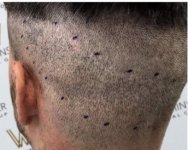
This example shows a moth eaten look that was the result from small areas being over harvested. Another risk of taking too many grafts in close proximity is keloid scarring. The smaller scars join up to form a larger one. This is why spacing is important.

24C0F316-3635-4221-BF42-FBE916C41EA7.jpeg
 

Guest!

Guest
It can also occur when the scars from the extractions are larger than normal (generally associated with poor surgical skills).
Screen Shot 2022-05-18 at 8.23.41 pm.png


n some cases the individual scars can join to form larger scars referred to as 'scarring convergence.' Future FUE harvests then become even more difficult.
 
NZK Medical

NZK Medical

Valued member
This example shows a moth eaten look that was the result from small areas being over harvested. Another risk of taking too many grafts in close proximity is keloid scarring. The smaller scars join up to form a larger one. This is why spacing is important.

View attachment 32728
As Bigmac says the moth-eaten look is common when there is little to no spacing between the extraction points. Skin healing is also a factor. Skin characteristics are largely determined by genre. Some skin properties heal better than others. Laxity is better, either leaving less visible signs of scarring or the size of scarring. Including the complexion or pigmentation alteration compared to virgin skin. The size of the tool can play into this.

The doctor may have their own preference for some aspects of the punch/extraction process. For instance, a preference for a sharp punch edge. As opposed to a dull. Even the technique of punching the skin. More so when using a manual tool. Whether to twist on entry or push down. For some time, most FUE doctors have been using a punch below 1mm in diameter, and some a much smaller diameter. While the outer diameter of the punch affects the size of the wound created. Natural healing properties also have an impact on how that wound will then shrink as it heals. As a result, it is a combination of factors. Not all are within the direct control of the Doctor. That said, this leads to staying within a well-considered extraction pattern. Be that the numbers are removed, the surface area they are removed from.
 
Top