R


-
Welcome to Hair loss Experiences hair loss forum.
Free impartial hair loss advice, hair transplant advice, hair loss medications and hair loss news.
You can contact us directly at [email protected] if you experience any problems.
You are using an out of date browser. It may not display this or other websites correctly.
You should upgrade or use an alternative browser.
You should upgrade or use an alternative browser.
R
royroy
Valued member
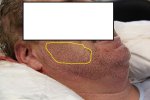
I sure hope it heals. Not sure why they went up in the cheek as you say I dont feel comfortable with extractions there either. If you look at this picture of the left side I wish they had taked those 100-150 (circled in pic above) or so from the right cheek out of this yellow area I circled instead. They say they needed to come up in that cheek area because my beard is weak and I wanted 800 or so FUE's but in my opinion if they would have utilized both sides equaly we could have got 800 from sideburns, chin, and neck. I really would like to really maximize the neck since its hard to see. Anyhow thats all water under the bridge and I just hope to heal up somehow. Really just praying that Fraxel could help.
Attachments

Last edited:

sl
BHR Clinic Patient Advisor
After surgery it is natural when a punch is made to the skin a healing process starts, and part of this is the formation of a scab over the open wound, as the platelets come together at the wound they form a clot like a natural plaster, keeping bacteria out and preventing further blood loss. The formation of the crust is vital to the healing of the wound and how it heals and can determine whether there are any blemishes left once healed. The time frame can be different for people so a broad outlook has to be given, but normally by around 2 weeks, depending on the nature of the cut, the scab will fall off completely. The new skin underneath is fresh and healed.
The temptation to scrape a scab away, regardless how small can be big, simply the look and wanting to get back to normal as fast as possible, the logic can be to remove it, but it's best to leave it alone, removing the surface may cause damage to the skin due to abrasion, may cause a fresh wound and can certainly prolong the healing process.
Continued abrasiveness to the skin over a wound will certainly slow down the healing as the skin has little time to relax and go through the necessary healing process correctly. Avoid the use of harsh exfoliating scrubs or anything that scrapes over the skin, as well as very hot water that can make the skin red, albeit for a minimal time, the increase can affect the healing. As said normally for about 2 weeks, I personally waited longer before properly shaving as a precaution.
Healing process can be helped by gently applying an anti bacterial wash to the area, gently with no pressure and washing off with warm, but not hot water, this helps to loosen and soften the area. Using emollients with vitamin E or aloe vera for example with an antibiotic cream to keep it clean and speed up the healing, improve the wound closure and effects to the skin as well as keep the area moisturised.
Different areas of the body may heal faster, better than others, dependent on skin type, the amount of wear and tear on the area, for example a scab on our knee joint would probably take longer to heal simply due to the movement all the time and not having time to rest, same can be said with the beard, shaving for example is removing the skin surface and slowing down the healing process, and the more we do, and how often will have an effect, even down to the blade or electric can change the healing process slightly due to their different abrasive natures.
In respect of the extraction pattern, the hair under the chin was very minimal and a high % of miniaturisation in the area, so the amount that could be harvested was not going to be high, and it was necessary to harvest more above the chin area, and we achieved the numbers required and discussed. Other areas under the chin that had a higher hair density were in an area hard to extract from due to the skin laxity; the skin laxity make punch extraction less precise, potential for increasing transection is high as is the chance of visible scaring, so in the interests of the patient and as explained this area cannot be used, simply there is no purchase on the skin to effectively be able to extract. This is not something that has a concern; the area was not over harvested or in the doctor s opinion would in any way hinder the healing of the skin. It is something we have performed on many occasions with different patients and healing has always been good. The numbers, well, we are considered to be rather conservative in our approach to body/beard hair harvesting, The amount we are extracting now has increased over the last year or so but is still low in relation to some other doctors. We have our own protocols as other do, and for us we feel more comfortable with smaller sessions, feeling it allows for better healing and long term potentially more hair to harvest due to less trauma being caused.
The temptation to scrape a scab away, regardless how small can be big, simply the look and wanting to get back to normal as fast as possible, the logic can be to remove it, but it's best to leave it alone, removing the surface may cause damage to the skin due to abrasion, may cause a fresh wound and can certainly prolong the healing process.
Continued abrasiveness to the skin over a wound will certainly slow down the healing as the skin has little time to relax and go through the necessary healing process correctly. Avoid the use of harsh exfoliating scrubs or anything that scrapes over the skin, as well as very hot water that can make the skin red, albeit for a minimal time, the increase can affect the healing. As said normally for about 2 weeks, I personally waited longer before properly shaving as a precaution.
Healing process can be helped by gently applying an anti bacterial wash to the area, gently with no pressure and washing off with warm, but not hot water, this helps to loosen and soften the area. Using emollients with vitamin E or aloe vera for example with an antibiotic cream to keep it clean and speed up the healing, improve the wound closure and effects to the skin as well as keep the area moisturised.
Different areas of the body may heal faster, better than others, dependent on skin type, the amount of wear and tear on the area, for example a scab on our knee joint would probably take longer to heal simply due to the movement all the time and not having time to rest, same can be said with the beard, shaving for example is removing the skin surface and slowing down the healing process, and the more we do, and how often will have an effect, even down to the blade or electric can change the healing process slightly due to their different abrasive natures.
In respect of the extraction pattern, the hair under the chin was very minimal and a high % of miniaturisation in the area, so the amount that could be harvested was not going to be high, and it was necessary to harvest more above the chin area, and we achieved the numbers required and discussed. Other areas under the chin that had a higher hair density were in an area hard to extract from due to the skin laxity; the skin laxity make punch extraction less precise, potential for increasing transection is high as is the chance of visible scaring, so in the interests of the patient and as explained this area cannot be used, simply there is no purchase on the skin to effectively be able to extract. This is not something that has a concern; the area was not over harvested or in the doctor s opinion would in any way hinder the healing of the skin. It is something we have performed on many occasions with different patients and healing has always been good. The numbers, well, we are considered to be rather conservative in our approach to body/beard hair harvesting, The amount we are extracting now has increased over the last year or so but is still low in relation to some other doctors. We have our own protocols as other do, and for us we feel more comfortable with smaller sessions, feeling it allows for better healing and long term potentially more hair to harvest due to less trauma being caused.

Sparky
Valued member
I think your chin looks normal for 7 weeks post op, don't going rushing into Fraxel.

topccat29
29 year HT veteran
royroy, it seems like you are asking for advice. My advice would be to slow down. It s not a good idea to jump from one thing into another and in this case Fraxel. I suggest doing absolutely nothing and just let the body heal as it knows how to do it on its own and at its own pace
Most people when confronted with an issue such as this are too quick to seek medical treatment which is a conditioned response. Usually it is not necessary and often times it just exacerbates the situation or leads into further complications. Of course the person offering Fraxel will tell you that is what you need. Why would anyone expect a difference response?
Personally I would approach a problem such as this by looking at what am I doing. It might be a little easier for me because I follow a specific dietary protocol and lifestyle and I rarely stray from it. So I can go back and ask myself what did I do differently that made me feel differently or perform differently.
I would start by going back in time, putting pen to paper and writing down everything that I did over the past 7 weeks. Did I drink alcohol, smoke, prescription medicines, OTC medicines, specific foods and such? I would then decide if it was something that helped or hindered the healing process and then make the necessary adjustments. It would probably be a good idea to stop shaving for several weeks. Maybe it might be a good idea to switch to an electric shaver as it does not exfoliate the skin like a blade. Imagine having a wound anywhere else on the body and then taking a blade and shaving over that same wound on a daily basis, not a good idea to promote healing in my opinion.
Of course this advice might not be easy to follow. Otherwise we would not have a population with so many health issues, but I believe it to be very solid advice and I think you should give it a try. This is just my personal opinion as I have learned over time many do not agree with it.
Most people when confronted with an issue such as this are too quick to seek medical treatment which is a conditioned response. Usually it is not necessary and often times it just exacerbates the situation or leads into further complications. Of course the person offering Fraxel will tell you that is what you need. Why would anyone expect a difference response?
Personally I would approach a problem such as this by looking at what am I doing. It might be a little easier for me because I follow a specific dietary protocol and lifestyle and I rarely stray from it. So I can go back and ask myself what did I do differently that made me feel differently or perform differently.
I would start by going back in time, putting pen to paper and writing down everything that I did over the past 7 weeks. Did I drink alcohol, smoke, prescription medicines, OTC medicines, specific foods and such? I would then decide if it was something that helped or hindered the healing process and then make the necessary adjustments. It would probably be a good idea to stop shaving for several weeks. Maybe it might be a good idea to switch to an electric shaver as it does not exfoliate the skin like a blade. Imagine having a wound anywhere else on the body and then taking a blade and shaving over that same wound on a daily basis, not a good idea to promote healing in my opinion.
Of course this advice might not be easy to follow. Otherwise we would not have a population with so many health issues, but I believe it to be very solid advice and I think you should give it a try. This is just my personal opinion as I have learned over time many do not agree with it.
topccat29
29 year HT veteran
royroy, please do not misconstrue my advice as blaming the patient. Nothing could be further from the truth. I honestly believe my advice is the best place to start.
Recently I was reviewing some of the speeches I have given locally in front of a small group. All of them are on health issues. One in particular had to do with bras and breast cancer. People that smoke have a 10-30 times greater chance to develop lung cancer then a non smoker. Yet a woman that wears a bra 24 hours a day has a risk of breast cancer that is 125 times higher than one that does not. This has to do with hindering the flow of lymph fluid through the body. This forum is not the place for me to go into detail. But the point is sometimes it is something that we are doing that just requires a simple change and medical intervention is often not necessary.
Recently I was reviewing some of the speeches I have given locally in front of a small group. All of them are on health issues. One in particular had to do with bras and breast cancer. People that smoke have a 10-30 times greater chance to develop lung cancer then a non smoker. Yet a woman that wears a bra 24 hours a day has a risk of breast cancer that is 125 times higher than one that does not. This has to do with hindering the flow of lymph fluid through the body. This forum is not the place for me to go into detail. But the point is sometimes it is something that we are doing that just requires a simple change and medical intervention is often not necessary.
R
royroy
Valued member
Stephen/Sparky/Topccat,
Thanks for your replies. As for this looking normal at 7 weeks the feedback I am getting from BHR is that this has never happened before to any beard fue patient. I am the only person they have ever had that looked like this 7 weeks later. All of their patients have healed up in a very short time. I am baseing my concern on this fact. If I was told that everyone looked like this at 7 weeks and it took 3 months to heal then I would just exercise more patience. Since the feedback I am getting is that I am the "freak" (not their words, mine) case I am studying options. One of my reasons for posting is to hear back from other beard fue guys, did you look like this at 7 weeks or not? Wish so but I have never seen or heard of a case where guys didn't heal up in an extremely quick time. Most of these guys have no holes, just redness at 1 week.
Topccat, I agree with your approach, but I don't know what to single out. I don't smoke. I have not had an alcoholic drink since my procedure. I am applying 2% hydrocotozone mixed 50/50 with aloe vera to my face twice a day per the Doctors instruction. My diet is horrible and has always been bad. If there are foods to eat I'd love to try them. I had arthroscopic knee surgery 3 weeks ago and have healed so fast it is amazing. The Doctor knows I was having this surgery just a month after fues and said it would not be a problem. I dont think it was a factor as the face hasn't healed well before or after the knee surgery even though the knee healed up in very short order. I only mention that because though I have a very poor diet it apparently didnt affect my knee or the last 2 HT's I had in 2008, 2009?
Stephen, You mention an anti bacterial cream? Is this something other then the hydrocortozone and aloe. I am just following Doctors orders, if there is another cream I should be using please let me know. Shaving does inflame the area a little but I notice it stays inflamed when I dont shave. I havent shaved since Tuesday and it doesn't look any better. I am not going to wet shav again until this thing is over, God willing that it ever is over. The Doctor has agreed that it is not a bad idea to consult with my Fraxel guy and my Doctor that has done my last two HT strip proceedures to see what they think (because I am in US and Doctor is in Europe). If I can get this healed up I will post all my resuts for future researchers. I dont want to rush into Fraxel or any other action. I guess my biggest concern is that I am not showing weekly improval, even if very slight. I look exactly at week 7 as I did at week 6. In fact the difference between week 7 and week 3 is almost indecernable. In any event thanks for your replies and ideas.
Thanks for your replies. As for this looking normal at 7 weeks the feedback I am getting from BHR is that this has never happened before to any beard fue patient. I am the only person they have ever had that looked like this 7 weeks later. All of their patients have healed up in a very short time. I am baseing my concern on this fact. If I was told that everyone looked like this at 7 weeks and it took 3 months to heal then I would just exercise more patience. Since the feedback I am getting is that I am the "freak" (not their words, mine) case I am studying options. One of my reasons for posting is to hear back from other beard fue guys, did you look like this at 7 weeks or not? Wish so but I have never seen or heard of a case where guys didn't heal up in an extremely quick time. Most of these guys have no holes, just redness at 1 week.
Topccat, I agree with your approach, but I don't know what to single out. I don't smoke. I have not had an alcoholic drink since my procedure. I am applying 2% hydrocotozone mixed 50/50 with aloe vera to my face twice a day per the Doctors instruction. My diet is horrible and has always been bad. If there are foods to eat I'd love to try them. I had arthroscopic knee surgery 3 weeks ago and have healed so fast it is amazing. The Doctor knows I was having this surgery just a month after fues and said it would not be a problem. I dont think it was a factor as the face hasn't healed well before or after the knee surgery even though the knee healed up in very short order. I only mention that because though I have a very poor diet it apparently didnt affect my knee or the last 2 HT's I had in 2008, 2009?
Stephen, You mention an anti bacterial cream? Is this something other then the hydrocortozone and aloe. I am just following Doctors orders, if there is another cream I should be using please let me know. Shaving does inflame the area a little but I notice it stays inflamed when I dont shave. I havent shaved since Tuesday and it doesn't look any better. I am not going to wet shav again until this thing is over, God willing that it ever is over. The Doctor has agreed that it is not a bad idea to consult with my Fraxel guy and my Doctor that has done my last two HT strip proceedures to see what they think (because I am in US and Doctor is in Europe). If I can get this healed up I will post all my resuts for future researchers. I dont want to rush into Fraxel or any other action. I guess my biggest concern is that I am not showing weekly improval, even if very slight. I look exactly at week 7 as I did at week 6. In fact the difference between week 7 and week 3 is almost indecernable. In any event thanks for your replies and ideas.
Last edited:
sl
BHR Clinic Patient Advisor
We mentioned an anti biotic cream, you were given the normal hydrocortisone cream for the scalp FUE extractions and the anti biotic smaller tube of Neosporin for the beard FUE extractions. Two different creams for two different places as standard to be used for the first few weeks.
An indication to healing of skin maybe to compare the areas, the scalp extractions against the beard, it is unlikely the scalp area has had any abrasiveness, such as shaving.
An indication to healing of skin maybe to compare the areas, the scalp extractions against the beard, it is unlikely the scalp area has had any abrasiveness, such as shaving.
R
royroy
Valued member
Ok the neosporin is the antibiotic. I used that on the face for the first two weeks per your postop instructions. After that the Doctor told me to start putting the hydro 1% with aloe on the face which I have been doing. I havent put the neosporin on the face since the end of week 2 per instructions.
topccat29
29 year HT veteran
royroy, don t you think it would make sense to stop shaving for 4-8 weeks and let the skin heal?
Sparky
Valued member
I wouldn't of shaved for 2 months from day 1, maybe clippers to keep it from getting too long, but never a razor.
R
royroy
Valued member
Not disagreeing with you guys but they tell you to wait only 2 weeks. Most people really heal up considerably by then so its a none issue. For me maybe I should have waited way longer. Its hard to tell though because you cant tell how much you have or have not healed until you shave. I plan to not shave going forward. If I need to shave once a week or so (for work) I will use the electric.
Last edited:
M
mars
Valued member
I dont see how a shave would slow his healing down significantly,providing its a good gillette razor and he shaves say after a hot shower,the blades dont actually touch the skin after all..i know their is a small bit of friction but not enough to do real harm imo once the scabs are completely healed and the skin is smooth say 2 or 3 wks later,
That photo roy i presume is directly after you shaved could you post a photo a few days after shaving to see what it looks like?
That photo roy i presume is directly after you shaved could you post a photo a few days after shaving to see what it looks like?
topccat29
29 year HT veteran
mars when you shave you are exfoiliating the skin and removing the keratin layer which helps seal the skin and speed the healng process. The more keratin produced the faster the healing process.
By shaving skin that has not healed you are greatly hindering the healing process.
At this point it would make sense for royroy to stop shaving and maintain that keratin layer. It also might be helpful to add some foods into one's diet that help the body produce more keratin. As I stated before the body has the amazing ability to heal and repair itself when given the proper environment. Many find this notion absurd, and this is just my own opinion.
By shaving skin that has not healed you are greatly hindering the healing process.
At this point it would make sense for royroy to stop shaving and maintain that keratin layer. It also might be helpful to add some foods into one's diet that help the body produce more keratin. As I stated before the body has the amazing ability to heal and repair itself when given the proper environment. Many find this notion absurd, and this is just my own opinion.
Last edited:
sl
BHR Clinic Patient Advisor
We suggest waiting 2 weeks because over that time with no abrasiveness the skin has time to relax fully on most people, obviously as I said some heal faster than others so it is a yard stick and then down to good judgement of the patient thereafter.
The problem possibly here is there was evident shaving within that time, royroy told us at day 7 that he was wearing a "goatee" beard, but there were "signs of healing" and about 9 days post op he had a complete shave and sent us pictures of it also. This we felt and said to him was too early to start to shave and could hinder the healing process, as we say to all patients. It is a crucial time the first couple of weeks, be it beard or scalp. Nobody likes to not shave for a few weeks, I personally don't like it, but it is a matter of short term inconvenience to not hinder the healing process.
The problem possibly here is there was evident shaving within that time, royroy told us at day 7 that he was wearing a "goatee" beard, but there were "signs of healing" and about 9 days post op he had a complete shave and sent us pictures of it also. This we felt and said to him was too early to start to shave and could hinder the healing process, as we say to all patients. It is a crucial time the first couple of weeks, be it beard or scalp. Nobody likes to not shave for a few weeks, I personally don't like it, but it is a matter of short term inconvenience to not hinder the healing process.
R
royroy
Valued member
Stephen,
I dont believe I ever shaved the goatee part untill 3 weeks (could be wrong not positive). You are right though I think I did shave the rest of my face once before the 2 week mark maybe at 8 or 9 days.. Can't remember exactly but I sent you pics. If the shaving is a big deal please put it in your postop instructions. You give people all kinds of postop writen instructions and not one thing mentions shaving. Now you are blaming my results on when I did or didn't shave. If it is the biggest deal please give people instructions. You said on a number of occasion to wait 10 - 14 days. Your boss (can't remember his name) told me I could shave at one week. You said you waited 3 weeks. All different. Publish what you recommend. Dont do it in private conversations and e-mails and have it slightly different every time.
Stephen please do not make the mistake of trying to turn this into a blame game. I have tried to be very fair and cordial in this thread. To be perfectly honest all the problems I am having are related to extraction location. I have healed ok under the chin line. I have healed some out at the sideburns. The huge problem I am having is that I am not healing in the middle of my face. If my extractions were in places that were hard to see it wouldn't be a big deal. I really dont think you should take extractions out of the middle of someones face. Who knows it may be an area that just can't handle it. I dont know but it is just not a safe practice. I am trying to come on line seeking help. Please do not be coming on here finding a way to blame the patient.
I dont believe I ever shaved the goatee part untill 3 weeks (could be wrong not positive). You are right though I think I did shave the rest of my face once before the 2 week mark maybe at 8 or 9 days.. Can't remember exactly but I sent you pics. If the shaving is a big deal please put it in your postop instructions. You give people all kinds of postop writen instructions and not one thing mentions shaving. Now you are blaming my results on when I did or didn't shave. If it is the biggest deal please give people instructions. You said on a number of occasion to wait 10 - 14 days. Your boss (can't remember his name) told me I could shave at one week. You said you waited 3 weeks. All different. Publish what you recommend. Dont do it in private conversations and e-mails and have it slightly different every time.
Stephen please do not make the mistake of trying to turn this into a blame game. I have tried to be very fair and cordial in this thread. To be perfectly honest all the problems I am having are related to extraction location. I have healed ok under the chin line. I have healed some out at the sideburns. The huge problem I am having is that I am not healing in the middle of my face. If my extractions were in places that were hard to see it wouldn't be a big deal. I really dont think you should take extractions out of the middle of someones face. Who knows it may be an area that just can't handle it. I dont know but it is just not a safe practice. I am trying to come on line seeking help. Please do not be coming on here finding a way to blame the patient.
sl
BHR Clinic Patient Advisor
royroy,
No one is blaming so please do not feel to get defensive, you and I have had many emails, you have spoken with Dr. B in person on the phone and we have been backing you all the way with no indication we have blamed you at any time. But it is fact that is all, you did shave and against what was recommended, it was in writing to you from me on numerous occasions and verbally, maybe not in post op but we change post op to suit an individual, but it was in writing.
Phil, my boss said 2 weeks, and if you shave before it could hinder the healing, he remembers well because you mentioned how long I took to shave being such a long time and you said about going back to work soon after.
As for the placement, the healing assumed under the chin is good because you did not shave, also the scalp FUE extractions have healed I assume?, We have taken beard extractions above the chin on many occasions before, you were by far not the first and healing has been good. As said please do not see this as blame but when you say something we do have a right to reply and we have not suggested anything but the facts of healing.
No one is blaming so please do not feel to get defensive, you and I have had many emails, you have spoken with Dr. B in person on the phone and we have been backing you all the way with no indication we have blamed you at any time. But it is fact that is all, you did shave and against what was recommended, it was in writing to you from me on numerous occasions and verbally, maybe not in post op but we change post op to suit an individual, but it was in writing.
Phil, my boss said 2 weeks, and if you shave before it could hinder the healing, he remembers well because you mentioned how long I took to shave being such a long time and you said about going back to work soon after.
As for the placement, the healing assumed under the chin is good because you did not shave, also the scalp FUE extractions have healed I assume?, We have taken beard extractions above the chin on many occasions before, you were by far not the first and healing has been good. As said please do not see this as blame but when you say something we do have a right to reply and we have not suggested anything but the facts of healing.
R
royroy
Valued member
Stephen,
See my e-mails. Lets hold off on our little debate, I am extremely pissed right now about this situation and I know from experience it is best to calm down before going forward. I will address later. For the record my goatee area which was shaved the latest and by far the least is one of the worst healing areas. It is good below the chin but the goatee area above the chin is horrible. Phil said you personally always waited very long and he said in one week you could shave and it would look like a rash. Thats the problem with not having postop shaving instructions. I am not calling Phil a liar and he's not calling me one. We remember a different conversation. If shaving is the number one determinant on healing how can you possibly not address it in your postop instructions. Lets not go down the blame road. I have serious problems. They are not your fault. The extractions sites are way to risky. Because I have these problems they are in places that look bad. Period.
See my e-mails. Lets hold off on our little debate, I am extremely pissed right now about this situation and I know from experience it is best to calm down before going forward. I will address later. For the record my goatee area which was shaved the latest and by far the least is one of the worst healing areas. It is good below the chin but the goatee area above the chin is horrible. Phil said you personally always waited very long and he said in one week you could shave and it would look like a rash. Thats the problem with not having postop shaving instructions. I am not calling Phil a liar and he's not calling me one. We remember a different conversation. If shaving is the number one determinant on healing how can you possibly not address it in your postop instructions. Lets not go down the blame road. I have serious problems. They are not your fault. The extractions sites are way to risky. Because I have these problems they are in places that look bad. Period.
Sparky
Valued member
I still think you should wait before going down the fraxel route, 7 weeks is nothing to go by, my fue marks on my hairline were still visible at 7 weeks, but I didn't give it a 2nd thought, as it's only 7 weeks.
What have you got to lose by waiting? You can still fraxel a few months later if you see no improvement.
What have you got to lose by waiting? You can still fraxel a few months later if you see no improvement.
R
royroy
Valued member
As far as what I have to lose I have hundreds of holes in my face right out on my cheek and it is very embarrasing to walk around in public, at work, you name it. Maybe it shouldn't be but it is, who would feel comfortable walking around with a bunch of holes in your face. It doesn't look like a rash or anything because the holes are in little paterns. I have been doing this for 7 weeks I don't want to do it anymore. I haven't been out of the house socially in two months. The other problem I have with waiting is that I am not seeing weekly improvement. Even if improvement was extremely slow if it was happening at all that would encourage me to wait. I have appts. with 2 doctors this week (since BHR is in Europe). Dr. Bisanga said it would be a good idea to get these opinions since he will not be able to see me until late January. You can only see so much in pics you need trained Doctors to look at your skin. I had an appointment this morning with my strip HT Doctor who is a dermatologist for 20+ years as well this morning. I am meeting with my Fraxel guy Friday. Just to get their opinions. I got very bad news this morning from my HT/dermatologist guy who gave me his professional opinion that these holes will not heal. He believes they will improve and the redness will subside but he feels based on my situation at 7 weeks that there will be hundreds of pits. He hopes he is wrong but he just wanted to give my his honest opinion. Hopefully they will heal just because it is his professional opinion that they will not heal doesn't mean the won't. He obviously doesn't do beard fues so he is just basing this on his overall experience of being a dermatologist and ht surgeon for 20 years. He said he thought my fraxel guy could do a lot for me. He feels like this is going to be very treatable and he is very optomistic for me. He said I should go see my Fraxel guy and see what he says.
Last edited:
Similar threads
L
- Replies
- 3
- Views
- 384
J
B
- Replies
- 2
- Views
- 879


B
- Replies
- 3
- Views
- 1K
B