Hattingen Hair
Valued member
A vital aspect to achieve an aesthetically pleasing result is the placement of the follicular units in the recipient area.
As one loses their hair the styling can become more difficult with less options, and it is one reason why many elect to shave their hair after a while as the contrast between hair and scalp becomes less obvious. This basic is a fundamental of a hair transplant procedure also, but in reverse; hair of a certain length is required to give that contrast and illusion of fullness.
Hereditary hair loss (MPB) causes the hair shaft to shrink, become finer as well as lose colour or pigmentation, this process is known as miniaturisation. The reduction of the hair diameter inevitably leads to the loss of coverage over the head. The effect is not immediate but as the miniaturisation and hair loss increase more scalp becomes visible and this accentuates the reflection of light off the scalp showing clear signs that the genetic hair loss is in progress.
Although a hair transplant cannot replace like for like hair, which is impossible, the goal is to create the illusion of enough thickness of hair to block out the light from reflecting off the scalp giving the appearance of a dense head of hair.
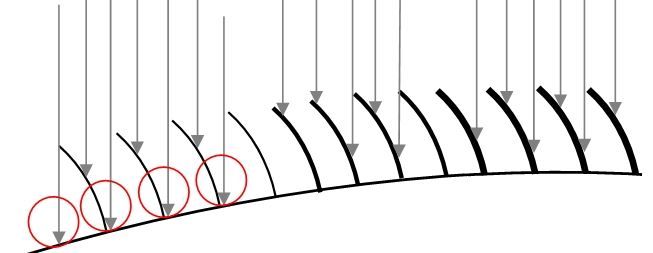
The longer the hair, the more shadow is produced and the more coverage is achieved. To achieve the best result from a hair transplant the hair must be a certain minimum length; this is a prerequisite to achieve the desired coverage and result.
There are exceptions to this with the right hair characteristics, low hair to skin colour, the angle of placement being more acute to the scalp but in general not many candidates will have all these aspects to achieve a very short hair cut.
If the hair is cut too short the result can look below par as there is little or no coverage of each hair over the next, the hairs basically do not lay over the next; this is a physical fact. It comes down to simply the law of physics that thick long hair will cover the scalp better than thin short hair.
With thick and long hair the light does not penetrate so easily to the scalp and reflects back less according to skin colour. As the goal of a hair transplant is to block the appearance of the skin there needs to be a reasonable compromise between graft density and the hair characteristics to achieve this. Therefore, it is aesthetic sense the transplanted hair is left to grow a little longer in order to increase their optical efficiency.
Other issues also help in producing a cosmetically acceptably looking density, the placement of the different graft sizes, 1,2,3 and 4 hair units, the angle and orientation of the placement and the actual density placed, dependent on the hair characteristics of the person. All have to be taken into account dependent on the goals of the person and the resources of the donor area.
As one loses their hair the styling can become more difficult with less options, and it is one reason why many elect to shave their hair after a while as the contrast between hair and scalp becomes less obvious. This basic is a fundamental of a hair transplant procedure also, but in reverse; hair of a certain length is required to give that contrast and illusion of fullness.
Hereditary hair loss (MPB) causes the hair shaft to shrink, become finer as well as lose colour or pigmentation, this process is known as miniaturisation. The reduction of the hair diameter inevitably leads to the loss of coverage over the head. The effect is not immediate but as the miniaturisation and hair loss increase more scalp becomes visible and this accentuates the reflection of light off the scalp showing clear signs that the genetic hair loss is in progress.
Although a hair transplant cannot replace like for like hair, which is impossible, the goal is to create the illusion of enough thickness of hair to block out the light from reflecting off the scalp giving the appearance of a dense head of hair.
The longer the hair, the more shadow is produced and the more coverage is achieved. To achieve the best result from a hair transplant the hair must be a certain minimum length; this is a prerequisite to achieve the desired coverage and result.
There are exceptions to this with the right hair characteristics, low hair to skin colour, the angle of placement being more acute to the scalp but in general not many candidates will have all these aspects to achieve a very short hair cut.
If the hair is cut too short the result can look below par as there is little or no coverage of each hair over the next, the hairs basically do not lay over the next; this is a physical fact. It comes down to simply the law of physics that thick long hair will cover the scalp better than thin short hair.
With thick and long hair the light does not penetrate so easily to the scalp and reflects back less according to skin colour. As the goal of a hair transplant is to block the appearance of the skin there needs to be a reasonable compromise between graft density and the hair characteristics to achieve this. Therefore, it is aesthetic sense the transplanted hair is left to grow a little longer in order to increase their optical efficiency.
Other issues also help in producing a cosmetically acceptably looking density, the placement of the different graft sizes, 1,2,3 and 4 hair units, the angle and orientation of the placement and the actual density placed, dependent on the hair characteristics of the person. All have to be taken into account dependent on the goals of the person and the resources of the donor area.