• Welcome to Hair loss Experiences hair loss forum.

    Free impartial hair loss advice, hair transplant advice, hair loss medications and hair loss news.
    You can contact us directly at [email protected] if you experience any problems.

Two consultations, two opposing opinions?

J

JFR8

Valued member
Following on from my previous thread: Advice before FUE consultation

I had a consult with Dr Ball (Maitland) in Nov and the outcome was promising. Good availability of Donor, lots of 3-4s and no obvious signs the donor was susceptible to DHT.

After some time to think, I decided it would be prudent to have a second consult which was complicated by lockdowns for Omnicron. Bisanga was in London in Feb so his assistant was kind enough to keep me in mind and book me a slot.

It was a relatively short consult (10min) and the advice was completely the opposite:

- Lower then average donor density
- Higher then average levels of miniaturisation in the donor area.
- High demand (NW5/6) which concurs with Dr Ball.

Based on the above Bisanga didn’t feel I was a good candidate.

There has been around 3 months between the consults (due to Omnicron making it unfeasible to travel to Belgium). But I wouldn’t think things could have changed that quickly?

These are both reputable Surgeons, so I don’t thing it’s a case of either being driven by anything other then what’s best for the patient.

I put the idea on the back burner for a while, as I didnt want to have the procedure over summer anyway. But I'm still not sure how to proceed. In short I’m now confused and not sure what to do next. Third consult? With who? Go with Maitland? Or just give up on the idea.

Any help/advice greatly appreciated.
 
loui

loui

Valued member
Following on from my previous thread: Advice before FUE consultation

I had a consult with Dr Ball (Maitland) in Nov and the outcome was promising. Good availability of Donor, lots of 3-4s and no obvious signs the donor was susceptible to DHT.

After some time to think, I decided it would be prudent to have a second consult which was complicated by lockdowns for Omnicron. Bisanga was in London in Feb so his assistant was kind enough to keep me in mind and book me a slot.

It was a relatively short consult (10min) and the advice was completely the opposite:

- Lower then average donor density
- Higher then average levels of miniaturisation in the donor area.
- High demand (NW5/6) which concurs with Dr Ball.

Based on the above Bisanga didn’t feel I was a good candidate.

There has been around 3 months between the consults (due to Omnicron making it unfeasible to travel to Belgium). But I wouldn’t think things could have changed that quickly?

These are both reputable Surgeons, so I don’t thing it’s a case of either being driven by anything other then what’s best for the patient.

I put the idea on the back burner for a while, as I didnt want to have the procedure over summer anyway. But I'm still not sure how to proceed. In short I’m now confused and not sure what to do next. Third consult? With who? Go with Maitland? Or just give up on the idea.

Any help/advice greatly appreciated.
How long was the consultation with Dr Ball? What did he use to examine you?

I dont know how thorough the consultations is when they come abroad to another place like Bisanga did, his examinations are usually very detailed from what I have been reading on patient reviews when hes in Belgium.
 
J

JFR8

Valued member
How long was the consultation with Dr Ball? What did he use to examine you?

I dont know how thorough the consultations is when they come abroad to another place like Bisanga did, his examinations are usually very detailed from what I have been reading on patient reviews when hes in Belgium.

From memory it was about an 1-1.5 hours. Part of that was with David, pre and post consult discussions.

Dr Ball spent around 45 mins with me during the middle portion of the consult. Examining my current hair loss. Examining the donor area with a digital microscope. Pencilling on the proposed new hairline. Clarifying any points in family history, how my hairless had progressed, etc, that David had collected and passed to him.

Then also discussing what was possible in an initial surgery. And what may be possible going forward to address the crown, but he preferred to remain conservative and see how the first one went.

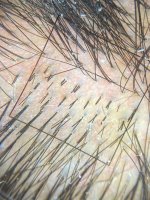
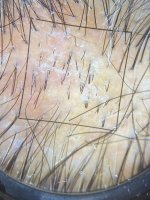
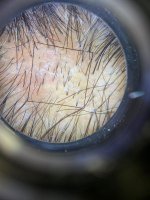
The consult with Bisanga was quite short (~10 mins). Again I'd already discussed all my history with his assistant over email. He checked the recipient area and current state of hair loss. Then he examine my donor before clipping back 3 areas and examined these with a digital microscope.
 
Bigmac

Bigmac

Administrator
Staff member
What are you wanting to achieve from surgery?
Would you be happy with a new hairline created to frame your face and then a thinner density behind that creates a good illusion to hide the scalp?

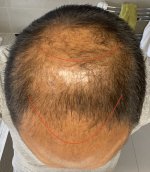
Some pictures of your donor and a side view would be helpful. It looks as though your lateral humps may be dropping. I’ve added your image from your other post to see.

7BED238A-6E44-4981-95B1-8BB356BD2E92.jpeg
 
J

JFR8

Valued member
What are you wanting to achieve from surgery?
Would you be happy with a new hairline created to frame your face and then a thinner density behind that creates a good illusion to hide the scalp?

Although i'd love to get it all back I realise thats not realistic given current solutions :)

Essentially what you've outlined is what my expectations/hopes are. That's roughly where I was 5/10 years ago. My hairline was receding and I was thinning on top, but I still found it aesthetically acceptable with an appropriate hair cut. Yes I was conscious of it, but not enough to consider surgery or think my appearance had completely changed.

Some pictures of your donor and a side view would be helpful. It looks as though your lateral humps may be dropping. I’ve added your image from your other post to see.

View attachment 33882

I''ll take some pictures of the side and donor and post them. But Dr Bisanga's assistant sent me some from my consult so i've attached them for now. Ignore the length of the hair, thats where he clipped it back close to the scalp before using the scope.
 

Attachments

  • unnamed.jpg
    unnamed.jpg
    196.2 KB · Views: 225
  • unnamed-3.jpg
    unnamed-3.jpg
    155.2 KB · Views: 202
  • unnamed-2.jpg
    unnamed-2.jpg
    149.4 KB · Views: 202
loui

loui

Valued member
Although i'd love to get it all back I realise thats not realistic given current solutions :)

Essentially what you've outlined is what my expectations/hopes are. That's roughly where I was 5/10 years ago. My hairline was receding and I was thinning on top, but I still found it aesthetically acceptable with an appropriate hair cut. Yes I was conscious of it, but not enough to consider surgery or think my appearance had completely changed.


I''ll take some pictures of the side and donor and post them. But Dr Bisanga's assistant sent me some from my consult so i've attached them for now. Ignore the length of the hair, thats where he clipped it back close to the scalp before using the scope.
Like @Bigmac said, to go conservative with the loss you have is the best way. You are a high NW and you need to have realistic expectations.
 
J

JFR8

Valued member
Like @Bigmac said, to go conservative with the loss you have is the best way. You are a high NW and you need to have realistic expectations.

I agree, I'm not expecting miracles. Just roll back 5-10 years, hopefully without it being obvious i've had a transplant. I know i'll still be looking at a receding hairline and obviously thinning top. But IMO (its all subjective of course) I looked a lot better with some sort of hairline to frame my face and some hair on top to diffuse the bare scalp showing.

My main concern is the two opposing opinions wrt donor from two reputable surgeons.
 
loui

loui

Valued member
I agree, I'm not expecting miracles. Just roll back 5-10 years, hopefully without it being obvious i've had a transplant. I know i'll still be looking at a receding hairline and obviously thinning top. But IMO (its all subjective of course) I looked a lot better with some sort of hairline to frame my face and some hair on top to diffuse the bare scalp showing.

My main concern is the two opposing opinions wrt donor from two reputable surgeons.
I understand your concerns as they said the opposite thing.

Maybe for you another in person consultation would be good.

If you do it try to tell the Doctor exactly how you want it to be done, to see his opinion om what you want and the measures he takes.

You seem to be located in the UK, maybe Dr Bessam Farjo or Dr Raghu Reddy could be two names to lookup how thorough their consultations is and what equipment they use to examine your scalp.
 
J

JFR8

Valued member
I understand your concerns as they said the opposite thing.

Maybe for you another in person consultation would be good.

If you do it try to tell the Doctor exactly how you want it to be done, to see his opinion om what you want and the measures he takes.

You seem to be located in the UK, maybe Dr Bessam Farjo or Dr Raghu Reddy could be two names to lookup how thorough their consultations is and what equipment they use to examine your scalp.

Yes i'm in the UK. With all the flight cancelations and travel chaos right now, another UK consult would be best. Wether that be a UK surgeon or like Bisanga, someone that comes here for consults periodically.

Thanks for the suggestions, I'll check them both out.
 
loui

loui

Valued member
Yes i'm in the UK. With all the flight cancelations and travel chaos right now, another UK consult would be best. Wether that be a UK surgeon or like Bisanga, someone that comes here for consults periodically.

Thanks for the suggestions, I'll check them both out.
You also have @NZK Medical that maybe can answer here how detailed they are in their examination.
 
NZK Medical

NZK Medical

Valued member
You also have @NZK Medical that maybe can answer here how detailed they are in their examination.

Thanks, @loui, Dr. Nikos starts with the donor hair characteristics. Hair qualities, follicular unit density, average hair count, etc. Under magnification. Without the quality of hair in the donor area, it really stops further discussion of hair restoration. This can be for a number of reasons. A higher than average % of hair miniaturisation. A generally low hair count. Low follicular unit density. Very fine hair calibre. If the donor is poor it really negates any hair restoration. Even if minimal restoration as it´s unlikely further hair restoration can be sustained. Or the hair quality will not blend well with the existing hair in the recipient.

Assuming the donor area is strong enough. The next step is to discuss the goals and expectations of the candidate. In line with the level of hair loss today. Against their age, whether using any hair loss treatments and the potential for future hair loss. The hairline design is often the next aspect. Occasionally the Dr may ask the person to design, to get an idea of what they are looking to achieve. On other occasions, Dr. Nikos may simply draw the hairline he would recommend. Then discuss the basis for his design. For instance, to ensure balanced hair coverage. While still looking to frame his face. Complement the facial bone structure etc. Often a hairline position is a compromise between doctor and patient. It´s important both are happy, especially the patient as it´s their hairline. That said, happiness within what is natural when grown out. Not simply agreeing to create a hairline the doctor knows will not look natural.

The hair density and coverage are normally the next aspects needing to be addressed. With higher NW patterns, there is a balance between spreading the hair at the expense of hair density. Or loading the density up at the expense of hair coverage. Even with a balance hairline position. You don´t want to front-load the hair restoration. It often has the opposite effect and highlights the untreated area. The density placed is going to be influenced by the natural quality of the hair characteristics. To create a natural-looking hair coverage, even with only partial hair coverage.

No different from the hairline discussion. It is important everyone is on the same page. The patient understands that if the doctor disagrees with a plan/idea. Then explains why they disagree. That the doctor has their best interests in mind and tries to push the individual in a better direction. For instance, spreading the hair to increase the area covered at the expense of hair density. Hardly ever works out well for anyone. Listening goes both ways. As the doctor listens to the patient. To ensure their goals are perfectly achievable and can be met. As a result, each hair transplant is different. As it´s not just about creating a natural hair restoration. But ensuring goals, expectations, and understanding of what is achievable are all met. Hopefully, then, everyone is happy with the result achieved.
 
J

JFR8

Valued member
Thanks, @loui, Dr. Nikos starts with the donor hair characteristics. Hair qualities, follicular unit density, average hair count, etc. Under magnification. Without the quality of hair in the donor area, it really stops further discussion of hair restoration. This can be for a number of reasons. A higher than average % of hair miniaturisation. A generally low hair count. Low follicular unit density. Very fine hair calibre. If the donor is poor it really negates any hair restoration. Even if minimal restoration as it´s unlikely further hair restoration can be sustained. Or the hair quality will not blend well with the existing hair in the recipient.

Assuming the donor area is strong enough. The next step is to discuss the goals and expectations of the candidate. In line with the level of hair loss today. Against their age, whether using any hair loss treatments and the potential for future hair loss. The hairline design is often the next aspect. Occasionally the Dr may ask the person to design, to get an idea of what they are looking to achieve. On other occasions, Dr. Nikos may simply draw the hairline he would recommend. Then discuss the basis for his design. For instance, to ensure balanced hair coverage. While still looking to frame his face. Complement the facial bone structure etc. Often a hairline position is a compromise between doctor and patient. It´s important both are happy, especially the patient as it´s their hairline. That said, happiness within what is natural when grown out. Not simply agreeing to create a hairline the doctor knows will not look natural.

The hair density and coverage are normally the next aspects needing to be addressed. With higher NW patterns, there is a balance between spreading the hair at the expense of hair density. Or loading the density up at the expense of hair coverage. Even with a balance hairline position. You don´t want to front-load the hair restoration. It often has the opposite effect and highlights the untreated area. The density placed is going to be influenced by the natural quality of the hair characteristics. To create a natural-looking hair coverage, even with only partial hair coverage.

No different from the hairline discussion. It is important everyone is on the same page. The patient understands that if the doctor disagrees with a plan/idea. Then explains why they disagree. That the doctor has their best interests in mind and tries to push the individual in a better direction. For instance, spreading the hair to increase the area covered at the expense of hair density. Hardly ever works out well for anyone. Listening goes both ways. As the doctor listens to the patient. To ensure their goals are perfectly achievable and can be met. As a result, each hair transplant is different. As it´s not just about creating a natural hair restoration. But ensuring goals, expectations, and understanding of what is achievable are all met. Hopefully, then, everyone is happy with the result achieved.

Thank you for the details. I see youre also in London, do you offer in person consultations? If so, how does one go about booking one?
 
NZK Medical

NZK Medical

Valued member
Thank you for the details. I see youre also in London, do you offer in person consultations? If so, how does one go about booking one?

Hello @JFR8, we do offer in-person consultations in London. Dr. Nikos is currently performing surgery in Athens for the next few weeks. He plans to come to London for surgery and consultations in August. I cannot give you the exact dates for consultations now. But will let you know, and hope it still fits with your plans. If you wished to have a virtual consultation with Dr. Nikos in the meantime, let me know. Send me a direct message or here. Best wishes,
 
J

JFR8

Valued member
Hello @JFR8, we do offer in-person consultations in London. Dr. Nikos is currently performing surgery in Athens for the next few weeks. He plans to come to London for surgery and consultations in August. I cannot give you the exact dates for consultations now. But will let you know, and hope it still fits with your plans. If you wished to have a virtual consultation with Dr. Nikos in the meantime, let me know. Send me a direct message or here. Best wishes,

Thank you.
 
Bigmac

Bigmac

Administrator
Staff member
Recently I saw an excellent response to meds from someone in a similar position to yourself.
 
J

JFR8

Valued member
Recently I saw an excellent response to meds from someone in a similar position to yourself.

What were the meds?

I tried Propecia briefly 15y ago, but had sides from it so I stopped. Sides reversed pretty quick, but I didnt dare try it again. I have been considering topical as I understand it has quite a short half life/bio availability. Moreover, other studies have suggested even small doses do a good job of supressing DHT levels. For example:

(Forum doesn't allow me to post links, but following quote is taken from ncbi article PMC3481923).

Doses of 0.2 mg are adequate to suppress both scalp skin and serum DHT levels. While 0.2 mg caused 55% DHT suppression, 5 mg per day achieved 69% DHT suppression.

Perhaps incorrectly, I presumed if I applied topically, it would give greater scope in finding a balance where the dosage is high enough to yield benefit, but low enough that systemic concentrations stay below levels that cause my side effects.

The problem is I can't find any reliable UK suppliers. For the above to work I need to be confident the topical has an accurate dosage and that its consistent across the entire bottle. If its variable, then it would be impossible for me to confidently control the dosage and figure out the right amount to use.

I still use Regaine foam daily. Caffeine shampoo as my regular shampoo (don't know if it makes a difference, but purely as a shampoo it suits my hair) and Nizoral every week or so.
 
J

JFR8

Valued member
It is Oral Minoxidil.

Here is the link to the article. https://www.ncbi.nlm.nih.gov/pmc/articles/PMC3481923/

You can add links now.

Have you looked at Forhims to see what they offer?

Thanks for enabling links.

Unfortunately there’s a history of cardio vascular disease in the family. My resting pulse (~60 bpm) and BP (~110/63) are pretty good, so hopefully that issue will skip me. But I do have familial hypercholesterolemia, which is probably one of the main contributing factors that’s led to that family history. So I’m reluctant to take oral minoxidil.

I haven’t checked out Forhims, I’ll take a look now.
 
J

JFR8

Valued member
Just taken a look at Forhims and they do both a topical and spray. Concentrations of Fin are listed for both. Obviously not sure how effective topical delivery is, but I could give it a try and administer less if sides started showing.

They offer a free consult for prescription, so think I may give it a go.

Are they reliable, generally trusted?
 
Top