What Problems Can Arise from Transplanting the Crown Too Early?
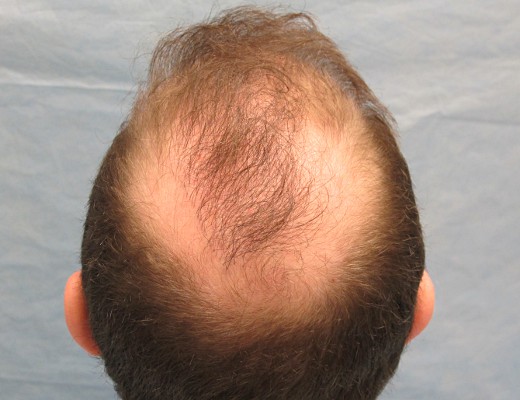
If a person’s hair loss continues – which is almost always the case – the crown will expand and leave the transplanted area isolated, i.e. looking like a pony-tail. The surgeon can perform additional hair transplant procedures to re-connect the transplanted area to the fringe, but, as one can see from the photo below, this is a large area that can require a lot of hair. It is often impossible to determine when a person is young if the donor supply will be adequate. If there is not enough donor hair, then the island of hair may remain isolated. Most importantly, it uses up a lot of hair that might be better transplanted to the front and top of the scalp – areas that are far more important cosmetically.
The front and top of the scalp are more important to one’s appearance than the crown, and these areas should be the first priority when planning hair restoration surgery.
As an exception, if a person has a family history of baldness limited to the crown, even at an advanced age, and the person in question is following this pattern, then earlier treatment of the crown may be considered.
Lastly, if you do treat the crown in a younger person, or one with whom the extent of hair loss is uncertain, the crown should be transplanted with light coverage only. That way a limited amount of hair will be used up in this area and there will be enough left over for the more cosmetically significant top and front of the scalp.